AI Strategy September 16, 2026
The Hidden Cost of Building Your Own Software
AI has made building software easier than ever. But building is only one part of the software lifecycle. We explore why owning, maintaining and evolving software can be a very different challenge.

"Hum bhi bana lenge"
It is a sentence that is becoming increasingly common. And honestly, it is easy to understand why.
In this day and age, AI has made software development easier than it has ever been. You can describe an application to an AI coding agent, generate the code, run it, find something you don't like, change it, and keep iterating.
What would have required a development team a few years ago can now be prototyped by a business owner sitting in front of a laptop. So why pay another company to build software? Why go through months of meetings, requirements, revisions, development and testing, only to end up with a product that may not work exactly the way you imagined?
Why not just build it yourself? The idea isn't wrong. In fact, for some problems, it can work remarkably well. You can open your laptop, describe what you want, build the first version and keep improving it until it solves the problem. But there is one thing that is easy to forget.
Building software is not the same as owning software.
Software Has a Lifecycle
There is a concept in software engineering called the Software Development Life Cycle (SDLC).
Despite the name, it is much bigger than simply writing code. NIST describes the system development life cycle as covering the entire journey of a system - from initiation and development to implementation, operation, maintenance and eventually disposal.
A simplified version looks something like this:
Idea → Requirements → Design → Development → Testing → Deployment → Operation → Maintenance → Updates → Retirement
And this is where AI changes the equation.AI has made development significantly easier. But the rest of the lifecycle still exists.
You still need to understand what needs to be built.
You still need to test it.
You still need to deploy it.
You need to manage the infrastructure.
You need monitoring.
You need to fix bugs.
And when the business changes, the software needs to change with it.
The Software Isn't Finished When You Deploy It
This is probably the biggest misconception around software.
You build it.
You deploy it.
Done.
Except it's not.
Once real people start using the software, things start happening. Someone finds a bug that you never encountered. An external API changes. A database needs to be migrated. Your business process changes. Your original assumptions turn out to be wrong.
Software maintenance exists precisely because software has to evolve after it is delivered. IEEE describes maintenance as modifying software after delivery to correct defects, improve performance, adapt to environmental changes or add new capabilities.
In fact, NIST describes the operational and maintenance phase as the activities required to keep software operational and responsive to its users after it enters production.
So when you build your own software, you have taken on another system that your business needs to operate.
“But AI Can Fix That Too”
Yes.
And this is where the argument gets interesting.
AI can help with debugging.
It can write tests.
It can explain unfamiliar code.
It can suggest fixes.
It can even help you deploy and monitor systems.
But there is a difference between being able to solve a technical problem and being responsible for the system that keeps your business running.
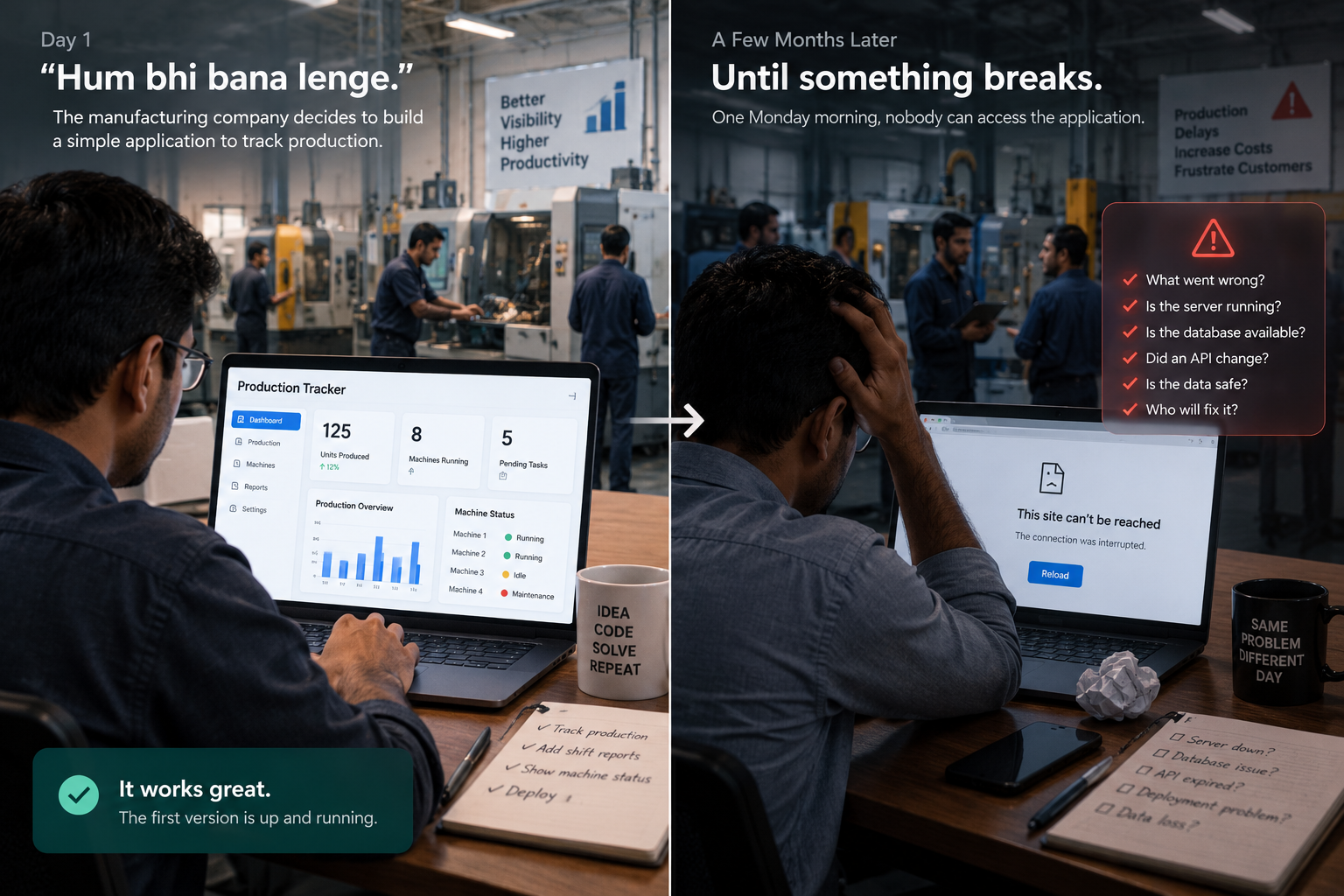
Imagine you run a manufacturing company.
You spend your day dealing with customers, suppliers, production, employees, finances and new business.
You build a small internal application to track production because, well...
“Hum bhi bana lenge.”
And you do.
It works beautifully.
For a while.
Then one Monday morning, nobody can access it.
Now you have a different problem.
You need to figure out:
What went wrong?
Is the server running?
Is the database available?
Did something change?
Did an API expire?
And perhaps the most important question:
Who is responsible for this system?
You Build It, You Own It
There is a well-known philosophy in modern software engineering:
“You build it, you run it.”
The idea is that responsibility doesn't end when developers finish writing the code. The people responsible for building a system also need to think about what happens when that system is running in production.
For a software engineer, that is part of the job.
For a founder or CXO, the question is different.
Your job is to build and grow the company.
You need to acquire customers, develop new business, build teams, improve operations, make strategic decisions and think about where the company should be five years from now.
Your job isn't necessarily to spend Tuesday evening debugging why the production server stopped responding.
And this doesn't mean that business owners cannot build software themselves.
They absolutely can.
The question is whether software development is where they should be spending their time and attention.
Because there is a difference between:
“I can build this.”
and
“I want to own everything that comes after I build this.”
Software Is Often Not the Product
This is something we strongly believe at Hexasphere.
For many businesses, software isn't actually the product.
It is a means to an end.
A manufacturing company doesn't necessarily want a beautiful dashboard. It wants fewer production delays. A services company doesn't necessarily want another project management application. It wants better visibility into its projects, resources and deadlines.
A business doesn't wake up thinking:
“I really need some software today.”
It has a business problem.
Software is simply one of the tools used to solve it.
And that's why we believe the conversation around software shouldn't start with:
“What can we build?”
It should start with:
“What problem are we trying to solve?”
AI has made the first question easier to answer. You can build almost anything. But that makes the second question even more important. Because building the software is only the beginning.
The real responsibility starts when people start depending on it.
At Hexasphere, we don't just look at software as a piece of code that needs to be delivered. We look at the entire lifecycle - understanding the problem, designing the right solution, developing it, deploying it and continuing to evolve it as the business evolves.
Because “Hum bhi bana lenge” might be true.
The more important question is:
“Uske baad kaun sambhalega?”