AI Strategy September 6, 2026
Do We Really Need AI?
AI is everywhere, but not every problem needs AI. We explore the difference between AI, ML, GenAI and LLMs, and why choosing the right technology matters more than simply adding AI to a product.
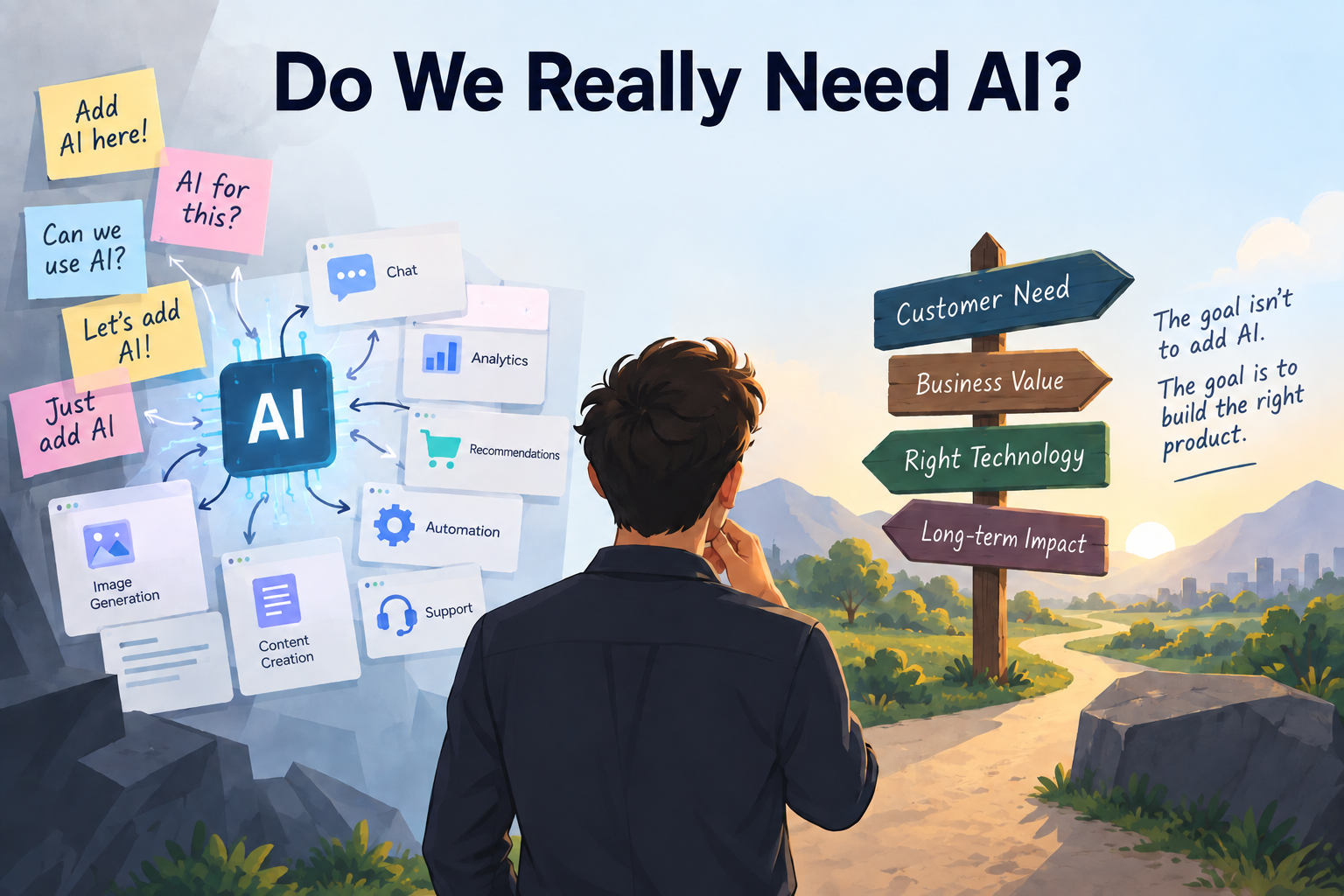
Do We Really Need AI?
“Can we add AI to this application?”
“Of course we can, but where exactly?”
“Um... I don’t know. I just want AI.”
I recently had this discussion with a potential client.
AI, LLMs, ChatGPT - all of these words have become synonymous with “the future”. And it might be true on some level. But truth be told, some things simply don’t require AI.
Several companies have changed their entire personas to become more “AI-adjacent”. Products that previously had little to do with AI are suddenly being marketed as AI-powered, and businesses are looking for ways to add AI to their existing products.
But is AI really worth the hype?
Before answering that, it is important to understand what we are actually talking about.
What is AI?
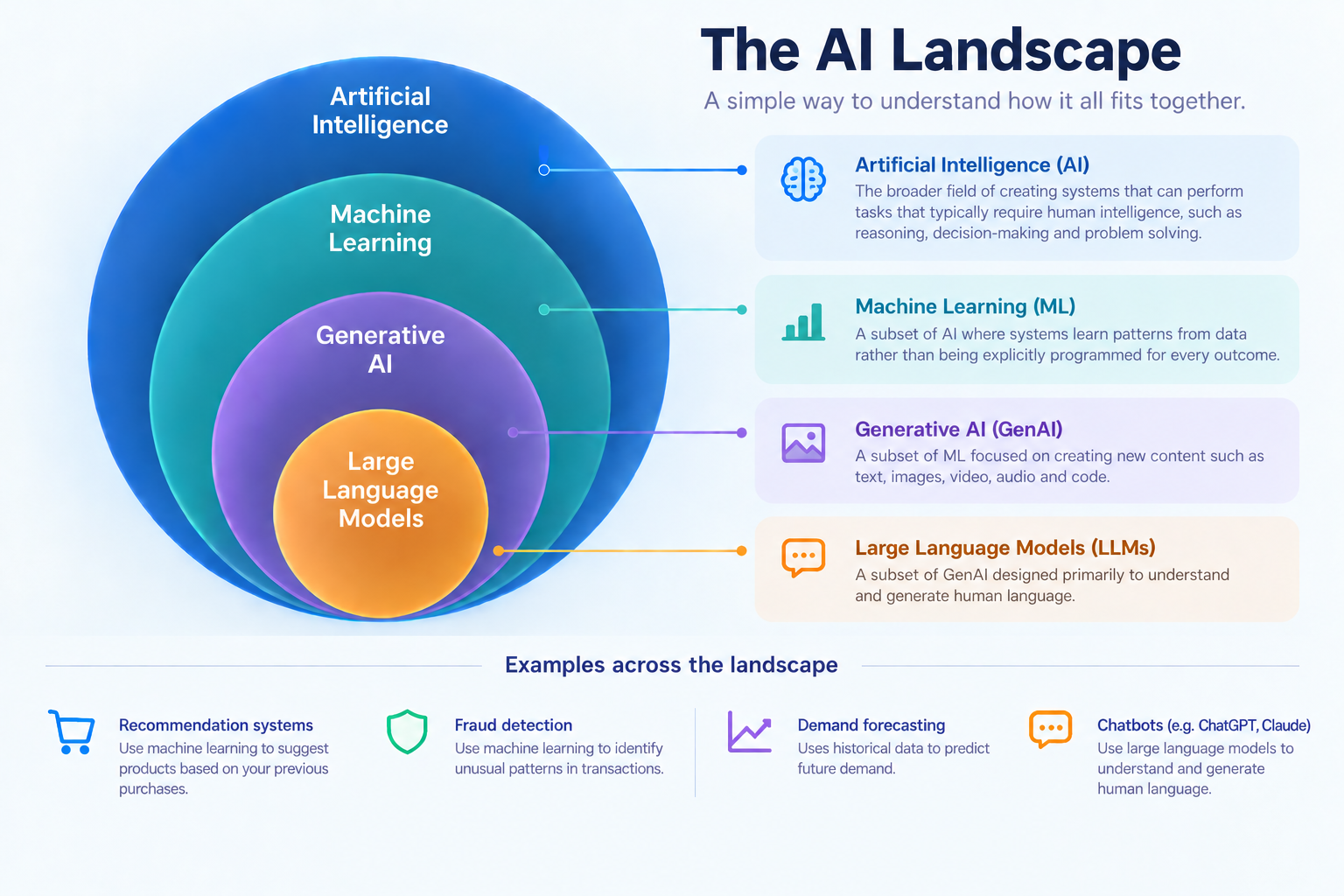
Artificial Intelligence, or AI, is the broader term used for systems that can perform tasks that normally require some form of human involvement, such as making predictions, recognising patterns, making decisions or adapting to changing conditions.
Machine Learning, or ML, is a subset of AI where systems learn patterns from data rather than being explicitly programmed for every possible outcome.
And this is where things start getting confusing.
People often use AI, Machine Learning, Generative AI and Large Language Models interchangeably. They are related, but they are not the same thing.
AI is a much broader field than just chatbots and generative tools.
A recommendation system can use Machine Learning to understand a user's preferences and suggest products they are likely to buy. A fraud detection system can analyse transaction patterns and identify behaviour that looks unusual. A demand forecasting system can use historical data to predict how much of a product might be needed in the future.
Then came Generative AI.
Unlike traditional AI systems that are generally designed to predict, classify or recommend, Generative AI focuses on creating something new - text, images, video, audio or even code.
And one of the most important technologies behind today's Generative AI boom is the Large Language Model, or LLM.
LLMs are designed to understand and generate human language. At a fundamental level, they work by predicting what token is likely to come next based on the patterns they have learned during training.
So, while AI is the broader umbrella, Machine Learning, Generative AI and LLMs represent different parts of that ecosystem.
GenAI, LLMs and Chatbots
Generative AI, or GenAI, refers to AI systems that can generate new content such as text, images, video, audio and code.
Large Language Models, or LLMs, are designed to primarily to understand and generate language. At a basic level, an LLM generates text by predicting what token is likely to come next based on patterns it has learned during training.
Applications like ChatGPT and Claude are built using LLMs.
A few years ago, I came across a description of LLMs that called them:
“The world's most expensive autocomplete.”
It sounds funny, but there is some truth to the analogy.
The technology behind these systems is incredibly powerful, but that does not mean that every problem requires one.
Does Everything Need AI?
Consider a simple expense management application.
If the requirement is to calculate the total expenses for a month, you don't need AI.
You need addition.
If you want to automatically categorise thousands of expenses based on patterns in historical data, Machine Learning might be useful.
If you want a user to ask, “How much did I spend on travel last quarter?” and receive an answer in natural language, an LLM could be useful.
And if you simply want to display the user's five most frequently used expense categories, a database query might be all you need.
Not every problem needs an AI solution.
Using AI for small things is like killing a mosquito with a missile.
And AI doesn't just add capability to a product. It can also add complexity.
Depending on how it is implemented, it can introduce additional infrastructure and inference costs, latency, privacy and security concerns, monitoring requirements, and the possibility of incorrect or unpredictable outputs.
If a simple rule, algorithm or database query can solve a problem reliably, adding an LLM may actually make the product worse.
The AI Rush
Everyone is talking about Artificial Intelligence, Machine Learning and Large Language Models.
They are affecting our jobs, behaviours and even our relationships.
Getting access to information has never been easier in the history of human civilisation. Earlier, people would Google something, go through several results, learn about the topic and come to their own conclusion.
Today, we can simply open an app on our phones and ask ChatGPT or another AI assistant for an answer.
The problem is that we can also blindly accept that answer without giving it a second thought.
Companies are replacing parts of their customer support operations with AI agents. AI is being used for everything from customer service and content generation to software development and data analysis.
And there is nothing inherently wrong with that.
The question is whether AI is being used because it is the right solution, or simply because everyone expects a product to have AI in it.
There is a difference.
So, Do We Need AI?
The answer, as usual, is: it depends.
AI is an incredibly powerful tool. But a tool is only useful when it is being used for the right problem.
At Hexasphere, we work with our clients to make sure that the right product is delivered, rather than simply adding the latest technology to an existing product.
We don't start with:
“Where can we add AI?”
We start with:
“What problem are we trying to solve?”
Sometimes the answer is AI.
Sometimes it is Machine Learning.
Sometimes it is an LLM.
And sometimes, the answer is simply a well-written if statement.
The goal isn't to add AI to a product.
The goal is to build the right product.